Transperineal vs. Transrectal Biopsy: Which Technique to Choose?
If you need a prostate biopsy, you are facing two techniques with very different approaches. Transrectal is the traditional one. Transperineal image-fusion biopsy is the current recommendation of the EAU 2024 and AUA 2023 guidelines — with 95% fewer infections and greater diagnostic accuracy. This is an objective comparison to help you make an informed decision.
Important: this content is educational. The final choice of biopsy technique should be made together with your urologist, considering your clinical history, the MRI result, your anatomy and the facilities available at the chosen center.
See visually why the transperineal route eliminates the infection risk associated with the transrectal route.
Objective comparison: 8 criteria
Analysis based on the latest evidence and the 2024 urology guidelines.
Criterion
Transrectal (Older Technique)
Transperineal Fusion (Current Standard)
1. Risk of infection / sepsis
2–5% (High risk)
<0.5% (95% lower)
2. Risk of bleeding
1–2%
<1%
3. Access to the anterior zone
Limited (often missed)
Excellent — reaches the entire prostate
4. Diagnostic accuracy
Systematic, “blind” template
Real-time fusion — 30–50% more detections
5. Need for antibiotics
Long course (3–5 days)
Usually a single dose
6. Recovery time
24–48h, simple restrictions
24–48h, similar restrictions
7. Cost / Coverage
Less expensive; covered by health insurance
Higher cost; covered when clinically indicated
8. Current recommendation
Not recommended as first choice
Primary recommendation of EAU 2024 and AUA 2023
Why the paradigm shift?
A closer look at the 4 pillars that made the transperineal route the worldwide gold standard.
Safety
Infection Risk
The most important difference. The transrectal route carries bacteria from the rectum into the prostate and can cause sepsis. The transperineal route passes through the clean skin of the perineum, practically eliminating this risk (rates <0.5%).
Reach
Access to the Anterior Zone
The anterior region harbors up to 30% of significant cancers and is difficult to reach through the rectum. Because of the direction of the needle (from below upward), the transperineal route naturally reaches the entire gland.
Technology
Diagnostic Accuracy
Image fusion overlays the MRI onto the ultrasound in real time. Instead of shooting “blind,” the needle is aimed precisely at the suspicious lesion, detecting more intermediate- to high-risk tumors.
Science
Guideline Recommendation
In 2024, the EAU (Europe) and the AUA (USA) began explicitly recommending: “transperineal access is recommended over transrectal access”, backed by large clinical studies (PRECISION, PROBE-PCa).
What the patient experiences
The typical step-by-step of a transperineal fusion biopsy in a hospital setting.
Preparation
Hospital Admission
The patient arrives at the hospital’s operating suite, fasting. A pre-anesthetic assessment is carried out and an IV line is placed for complete safety.
Procedure
Sedation and Sampling
Under deep intravenous sedation administered by an anesthesiologist, the software overlays the MRI images. Precisely guided samples are taken through the skin of the perineum, without puncturing the rectum. (Duration: 25-45 min).
Recovery
Same-day discharge
Comfortable recovery in the post-anesthesia room for about 30 to 60 minutes. Discharge takes place the same day; you walk out normally, accompanied by a family member.
What to consider in your decision
Use this checklist to talk with your urologist before the procedure.
About the Technique and Location
What is the sepsis rate at the chosen center?
Will the biopsy be guided by image fusion?
Will it be done in a hospital setting with an anesthesiologist?
Is the urologist a board-certified uro-oncologist (RQE)?
About Your Clinical Case
Is this a first biopsy or a repeat biopsy after a negative result?
Is there a suspicious lesion in the anterior zone of the prostate?
Is your PSA persistently high?
Do you have a history of antibiotic allergy?
Infrastructure and Technology
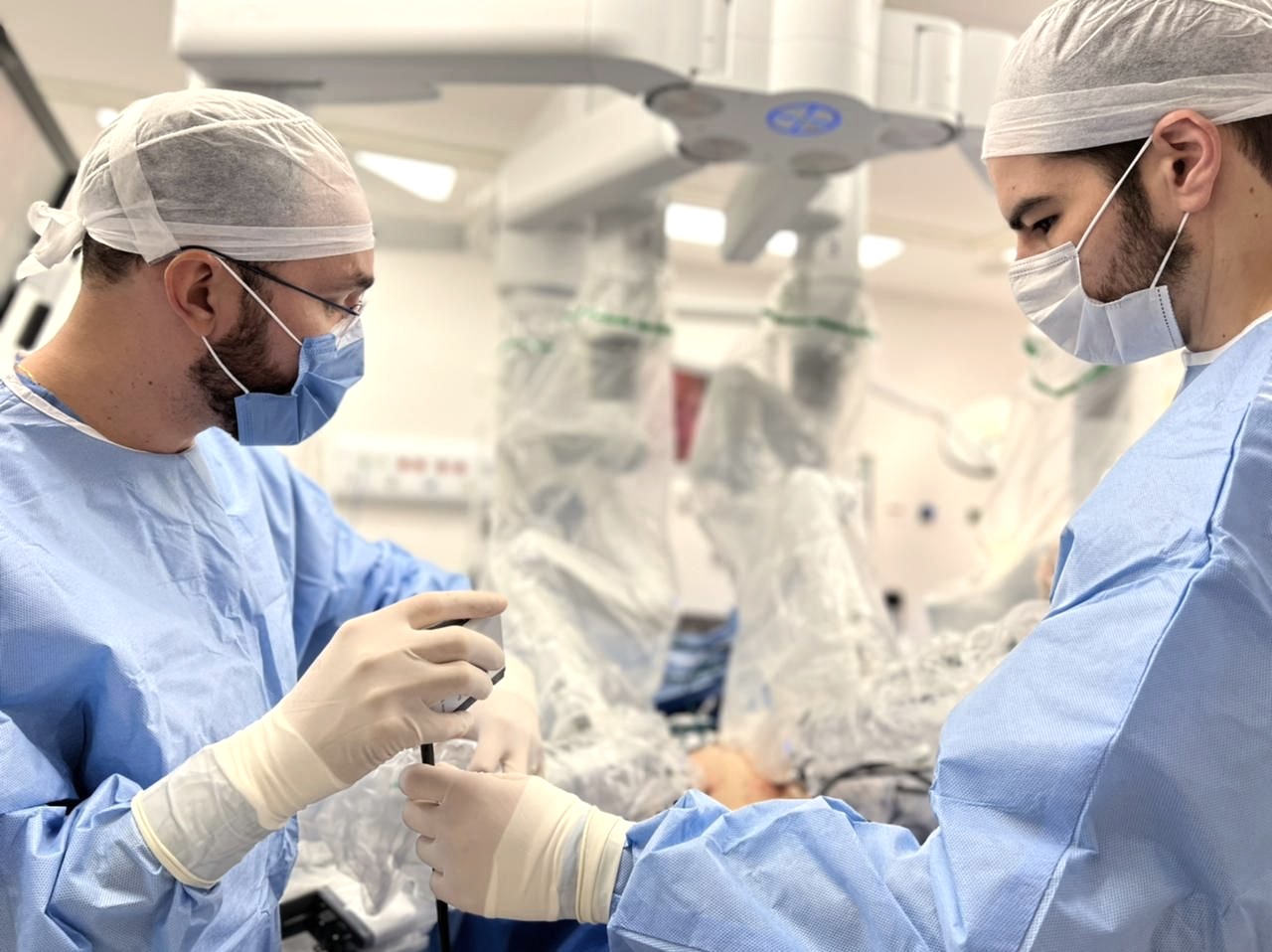
A proper hospital environment and state-of-the-art equipment for your safety.
Patient Experiences
What men who chose the transperineal technique have to say.
“I was very worried about the procedure after reading about the risks of the old biopsy. The sedation with the perineal approach was very smooth; I felt absolutely nothing and went home the same day.”
Carlos M.
Review via Doctoralia
“Dr. Bruno clearly explained the advantage of image fusion in my case, since my MRI showed a lesion in the anterior zone. A technical and transparent decision.”
Roberto A.
Patient, Hospital Oswaldo Cruz
“Excellent facilities and an attentive team. The recovery was exactly as described in the consultation. I recommend it to anyone who puts safety first.”
Get answers to your remaining questions about prostate biopsy techniques.
In general, yes — as long as your urologist has access to both techniques. Today, based on the EAU 2024 and AUA 2023 guidelines, transperineal fusion biopsy is the first choice whenever available. Transrectal biopsy remains a valid option in specific scenarios (local unavailability, unfavorable anatomy). What matters is that the choice is an informed one.
Yes, the major Brazilian health insurance plans cover MRI-fusion transperineal biopsy when there is a properly documented clinical indication — usually an elevated PSA and an MRI showing a suspicious lesion (PI-RADS ≥3), or a repeat biopsy after a previous negative result. Always check with your health insurance plan in advance.
Generally, yes. Because it is often performed in the office under local anesthesia, it costs less. But that difference must be weighed against the costs of a possible complication (hospitalization for sepsis) and against the risk of a false-negative result. The transperineal approach tends to be more cost-effective when the clinical outcome is taken into account.
The procedure itself takes 25–45 minutes. But the transperineal biopsy is performed in a hospital setting under sedation, so the patient is comfortable and asleep. Counting the total time at the hospital (admission, sedation, biopsy, recovery, discharge), patients usually stay 3 to 4 hours and go home the same day.
No. Studies show that fusion transperineal biopsy detects 30% to 50% more clinically significant cancers than systematic transrectal biopsy, especially in the anterior zone. It also tends to avoid diagnosing low-grade tumors that do not need treatment.
It is available at referral centers. Dr. Bruno Benigno performs the procedure at Hospital Alemão Oswaldo Cruz (Vila Mariana) and Hospital Vila Nova Star (Itaim Bibi), with image-fusion technology and a specialized anesthesia team.
Institutions where the procedure can be performed
Hospital Alemão Oswaldo CruzHospital Vila Nova StarHospital Sírio-LibanêsHospital Israelita Albert Einstein
Your next consultation with Dr. Bruno Benigno
When facing two techniques with important differences, the best decision is made in a conversation with a specialist — bringing your PSA, MRI and medical history. In-person consultations in São Paulo or via telemedicine.
Health insurance (reimbursement) or private (self-pay) consultations. Rua Borges Lagoa, 1070, Conjunto 131, Cobertura — Vila Clementino, São Paulo/SP
Medical content reviewed by Dr. Bruno Benigno, urologist and uro-oncologist (CRM-SP 126.265 · RQE 60022), based on AUA, EAU and NCCN guidelines. Last reviewed: