
Uro-oncology blog
Selected articles from Dr. Bruno Benigno’s blog, translated from Portuguese. More than 700 articles are available in Portuguese.

10 Things You Need to Know About the Double-J Stent.
What is a double-J stent? A double-J stent is a flexible tubular device 10 cm to 35 cm long, roughly the width of a ballpoint pen refill
Read the article →
At what PSA level should you worry? A urologist explains
Is high PSA always cancer? Urologist Dr. Bruno Benigno (CRM-SP 126265), uro-oncologist in São Paulo, explains normal values and when investigation is needed.
Read the article →
Free PSA/total PSA ratio of 0.28. Is there any risk?
Carmen Reis asks: Free PSA/total PSA ratio of 0.28. Is there any risk? The free/total PSA ratio is a parameter widely...
Read the article →
Double-J stent: 5 things you need to know.
A double-J stent is a thin, flexible device used to keep the urinary tract open. On his YouTube channel, Dr.
Read the article →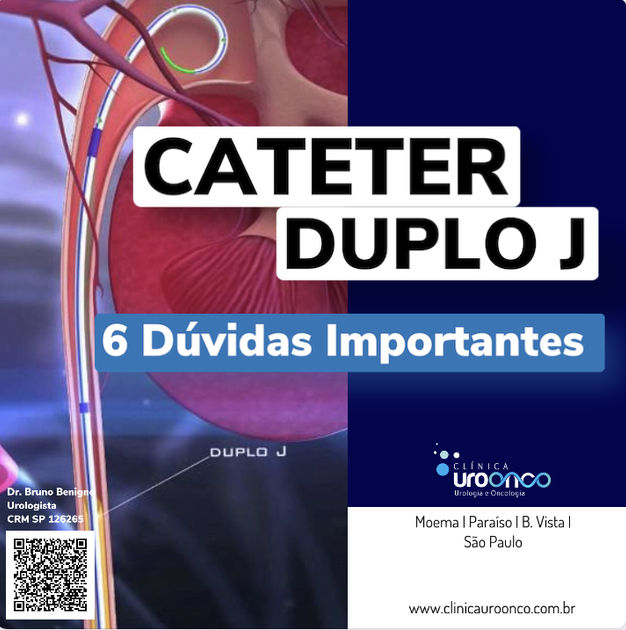
Double-J Stent - 6 important questions
Questions such as “can a patient with a double-J stent work?” or “is low back pain a symptom of kidney stones?” are very comm
Read the article →
Kidney stone surgery. What every patient needs to know.
Kidney stones are a common condition affecting millions of people worldwide. Fortunately, treatments are available to remove them.
Read the article →
How I treat it: kidney stones from 7 mm to 15 mm. A urologist explains
When diagnosing a patient with stones between 7 mm and 15 mm, a crucial factor is whether symptoms are present.
Read the article →
How to Pass a Ureteral Stone? Medication or Surgery?
Do you know the ways to eliminate a stone in the ureter? The ureter has three points where it is narrowest. The first one i
Read the article →
How to recover erections after prostate cancer surgery?
Erectile dysfunction is a side effect feared by most men who are about to undergo prostate cancer treatment. In
Read the article →
Side effects of testosterone suppression in men with prostate cancer
Side effects of testosterone suppression in men with prostate cancer: the role of testosterone, how blocking it works, its consequences and when it is needed.
Read the article →
Understanding Gleason 8: One of the Most Aggressive Forms of Prostate Cancer
Learn what Gleason 8 is, one of the most aggressive forms of prostate cancer, and the most effective treatment strategies. Contact our team.
Read the article →
Is there any way to lower PSA?
According to Dr. Bruno Benigno, there are several ways: with medication. Drugs that reduce prostate size, such as dutasteride or finasteride, also lower PSA.
Read the article →
Penile sores: 10 things you need to know.
HPV, phimosis, balanoposthitis, STDs? Urologist Dr. Bruno Benigno (CRM-SP 126265) explains when a penile sore needs specialist evaluation in São Paulo.
Read the article →
I had a prostate biopsy and it showed perineural invasion. What does it mean?
Perineural invasion means cancer cells were found around or along a nerve fiber inside the prostate. Find out what this means for you.
Read the article →
Kidney nodules and cysts: what are the risks and treatments?
Kidney nodules or cysts: do you know the risks and treatments? Learn the difference between them and which doctor to see.
Read the article →
WHAT YOU NEED TO KNOW ABOUT THE DOUBLE-J STENT
The double-J stent is a thin, flexible polyurethane tube, about 3 mm in diameter and 8 to 35 cm long, widely used by urologists. Here is what to know.
Read the article →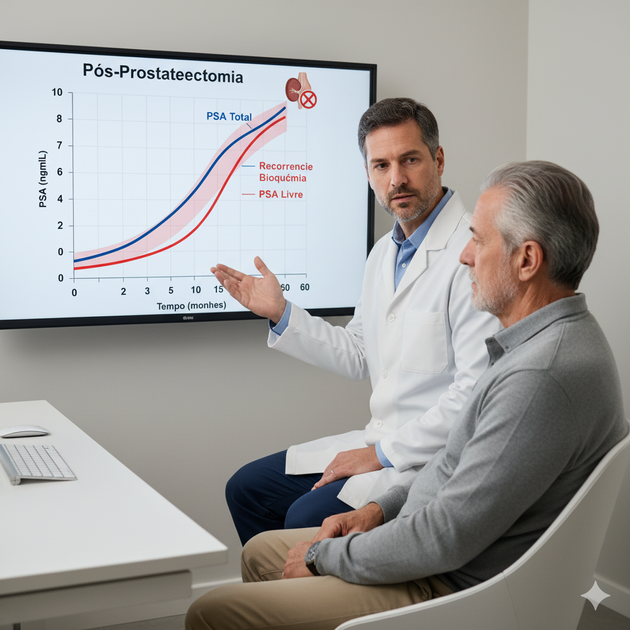
Biochemical recurrence after prostatectomy: when to worry about PSA?
Has your PSA started rising again after surgery? Understand what biochemical recurrence is, when to investigate it and how to treat it early.
Read the article →
What prostate size carries the highest cancer risk, and when should you worry?
Learn about prostate cancer: symptoms, risk factors, diagnosis and prevention, plus what prostate size, biopsy and PSA really mean for your risk.
Read the article →
What is the normal PSA level after prostate removal?
Why can PSA rise after prostate removal? Learn what is normal after surgery, how often to test, and the two reasons PSA can go up again.
Read the article →
My CT scan shows a 0.8 cm stone in my right kidney. Can it pass on its own?
My CT scan shows a 0.8 cm stone in my right kidney. Can it pass? Stones up to 7 mm have up to an 80% chance of passing without surgery. Learn your options.
Read the article →