This article was translated from the original Portuguese. Português
By: Dr. Bruno Benigno [ Urologist at Hospital Alemão Oswaldo Cruz SP and Director of Clínica Uro Onco } - CRM SP: 126 265

Which doctor should you see? Nephrologist or urologist?
When kidney nodules or cysts need to be removed, the urologist is the specialist responsible for performing the surgery, called a nephrectomy.
Urologists who focus on oncology tend to have more experience with complex cases, increasing the chances of removing the suspicious nodule without necessarily removing the whole kidney.
The nephrologist, on the other hand, does not perform surgical procedures but is responsible for monitoring and preserving the kidneys' filtering function before and after surgery.
What is the difference between a cyst and a nodule?
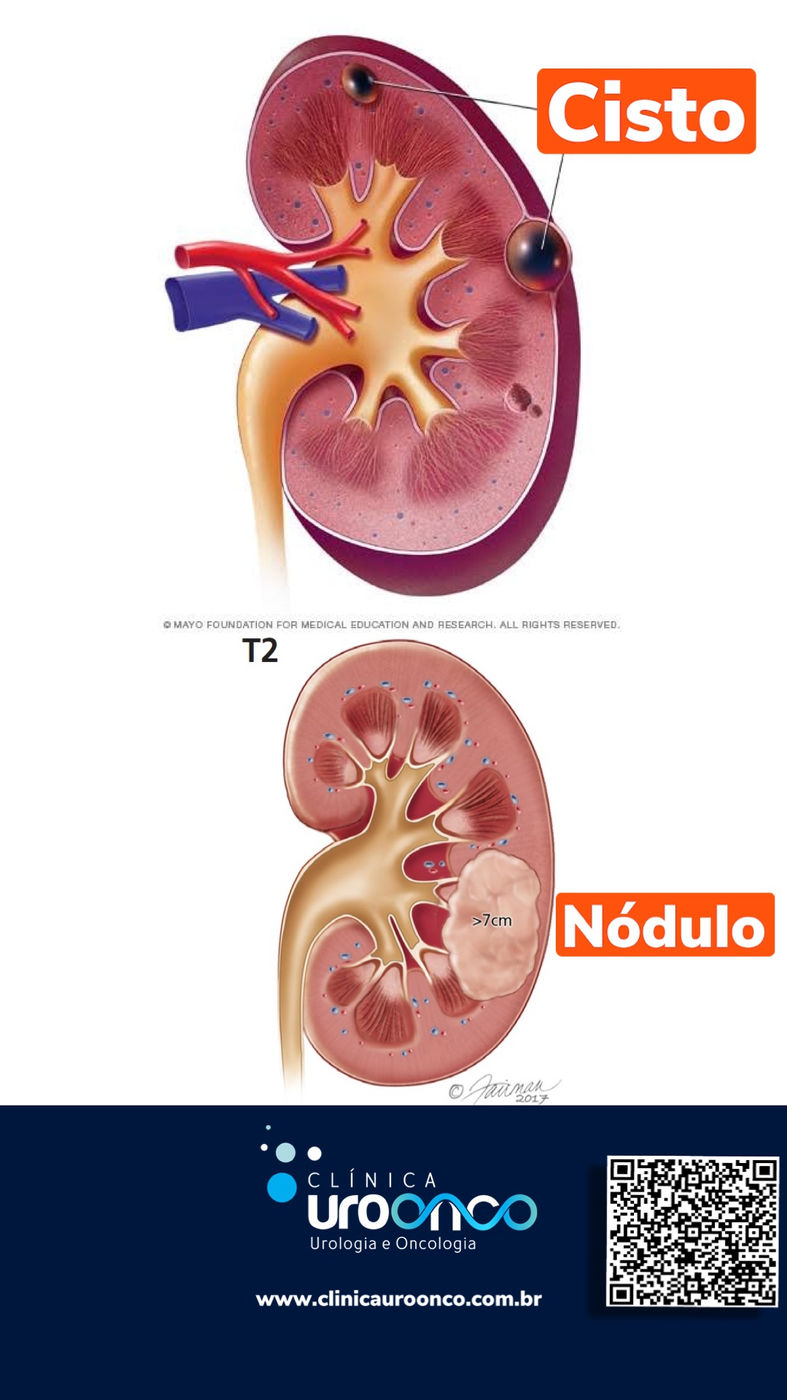
A cyst is any fluid-filled lesion in the kidney or in any other organ of the body. Nodules, by contrast, are solid and vascularized, can grow faster and are more likely to be malignant.
The larger the nodule, the more likely it is to contain cancer. The size of cysts, however, does not correlate directly with a higher or lower chance of developing cancer.
In general, kidney nodules are treated with surgery. Simple cysts with homogeneous content are usually managed with follow-up every 6 months only. Complex, vascularized cysts may carry a higher risk and are generally removed surgically (nephrectomy).(1)
What are the symptoms of a kidney nodule?
Most nodules or cysts cause no symptoms at all; they are usually discovered during routine tests performed for other reasons, such as an abdominal ultrasound.
After a cyst is detected on ultrasound, the patient usually undergoes a higher-resolution imaging test, such as an MRI or abdominal CT scan.
These tests can reveal more detailed features, such as shape, contour, vascularization and location in relation to the kidney's blood supply.
This information helps the medical team identify the best candidates for surgery and estimate the likelihood of removing the nodule without having to remove the entire kidney.
When the nodule has grown large within the abdominal cavity, the patient may experience back pain, weight loss or even blood in the urine.
Approximately 80% of cases are detected at an early stage, before any symptoms appear.(2)
The chances of cure are lower when the disease is discovered at an advanced stage or even with metastases (kidney cancer cells that have spread to other organs of the body).

What causes kidney nodules?
The causes of kidney cancer are not fully understood; the main risk factors are age over 65, obesity, a sedentary lifestyle, smoking or specific genetic syndromes (Von Hippel-Lindau).(3)
We know that a mutation in a gene that controls the formation of new blood vessels can trigger or even accelerate the multiplication of kidney cancer cells.
Other mechanisms involved are defects in the immune system's destruction of cancer cells, which leads to uncontrolled growth with infiltrative characteristics.
What are the symptoms of kidney cancer?
Most kidney nodules cause no symptoms of any kind. However, when they are diagnosed at advanced stages or are large, the main findings are symptoms such as back pain, blood in the urine, weight loss and a palpable abdominal mass.
Approximately 80% of all kidney tumors are detected incidentally, during routine ultrasound or CT scans performed to investigate unrelated symptoms.
Need a specialist evaluation?
Accurate diagnosis, an individualized plan and an integrated team — robotic surgery, medical oncology and rehabilitation in one place. In person in São Paulo or via telemedicine.
Book via WhatsApp Kidney cancerHow can you tell whether a nodule or cyst is cancer?
There are two ways to find out whether a kidney lesion is benign: a biopsy that removes a small sample for analysis, or surgery to remove the nodule or cyst completely. (4)
No imaging or blood test can confirm the definitive diagnosis. For this reason, in the vast majority of cases we recommend surgical removal of the lesion.
Is a vascularized nodule more dangerous?
Yes. Vascularization of a kidney nodule indicates the possibility of growth, invasion of surrounding organs or even spread of tumor cells to other parts of the body.
Although it is not enough to diagnose cancer, it is one of the most important features urologists take into account when deciding whether to recommend surgery.
Can a biopsy be done before surgery?
Yes. A biopsy can be performed before surgery. However, in 80% of cases surgery can be performed without the need to undergo a procedure of this kind.
Although imaging tests such as CT and MRI cannot confirm that a nodule is malignant, their findings can indicate with a high degree of certainty how likely a nodule is to be malignant.(5)
For this reason, we very often recommend removing the nodule even without
confirmation of malignancy.
How is the biopsy performed?
A biopsy is an invasive procedure performed with the patient under local anesthesia and light sedation. Most referral centers perform the biopsy guided by real-time images from a computed tomography (CT) scanner. This increases the accuracy of the test and reduces the risk of complications.
The sample removed is sent to a laboratory, and the result is usually ready within a week.
How much rest is needed after a kidney biopsy?
We recommend 48 hours of rest after a kidney biopsy. More strenuous physical activity, such as gym workouts, cycling and other activities that put strain on the abdomen, should be avoided for two weeks.
Do home remedies work for kidney nodules?
There are no reports in the medical literature of natural remedies with positive effects on kidney nodules or cysts.
Surgery is still the most effective method and offers the best chances of cure for malignant lesions.
What is the treatment for a kidney nodule?
The main treatment for kidney nodules or cysts is surgery. Removal of the nodule should be partial, preserving as much of the affected kidney tissue as possible.
Only when the nodule or cysts are very large, or in close contact with the kidney's blood supply, may surgery to remove the entire kidney be indicated.(6)
Laparoscopic (video) and robotic surgery have brought technological progress, reducing blood loss and providing less postoperative pain, shorter hospital stays and faster recovery.

Open, laparoscopic or robotic surgery?
All three techniques have similar cure rates. However, laparoscopic surgery or surgery using the robotic system allows the patient a faster recovery, less postoperative pain and
a lower risk of bleeding.(7)
The costs involved in robotic surgery still represent its main limitation.
Will I need radiotherapy or chemotherapy?
Radiotherapy has no effect in the treatment of kidney cancer. Chemotherapy is used only when the disease has spread to several organs, known as the metastatic stage.
Surgery is the main treatment method, but its benefit is limited to patients who do not have metastatic disease.
Written by:
More than 1,000 patient reviews
See what patients treated by Dr. Bruno Benigno say on Doctoralia.
See reviews Book a consultationUro-oncology evaluation with Dr. Bruno Benigno
Accurate diagnosis, an individualized plan and an integrated team — robotic surgery, medical oncology and rehabilitation in one place. In person in São Paulo or via telemedicine.
Book via WhatsApp Kidney cancer
Dr. Bruno Benigno
Urologist and uro-oncologic surgeon (CRM-SP 126.265 · RQE 60022). More than 1,500 robotic surgeries. Member of the AUA, EAU and SBU. Meet Dr. Bruno · In the Media
This content is educational and does not replace a medical consultation. Each case must be assessed individually, based on AUA, EAU and NCCN guidelines.